
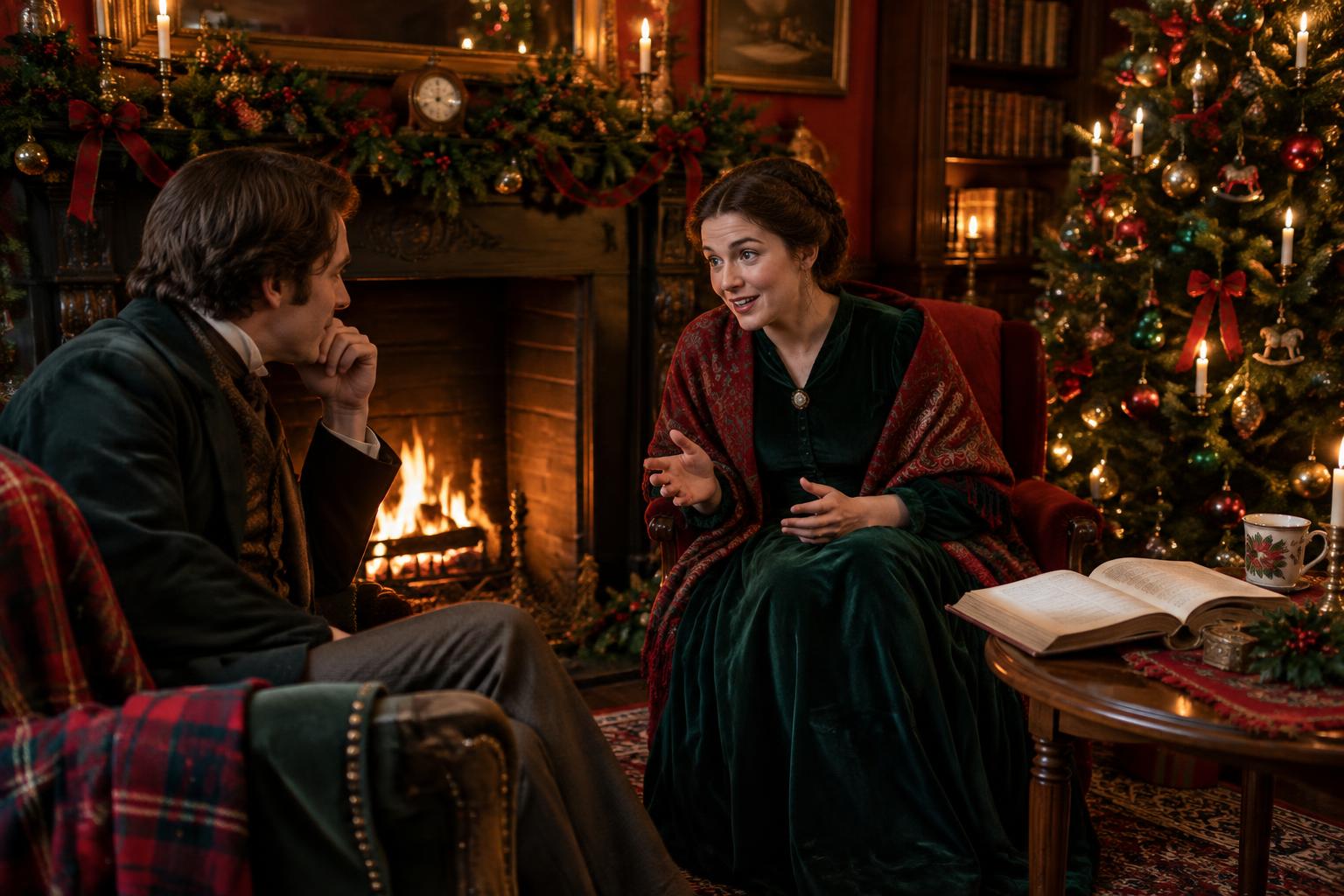
Bah humbug! A Christmas favourite with a serious beginning
You probably know how it goes. A miser, a rattling chain, three spirits and a Christmas morning that changes everything. Whether your favourite version stars Alastair Sim, the Muppets or another memorable Scrooge, A Christmas Carol feels made for a December evening.
But where did Charles Dickens get the idea? Not from a single spooky encounter. Behind the ghosts was something real and far less cosy: the hardship of children in Victorian Britain. Dickens turned that concern into a story people could feel, rather than simply a problem they could read about and forget.
When was A Christmas Carol written and published?
Dickens wrote the novella in the autumn of 1843. It was first published on 19 December 1843, just before Christmas. Its full original title included the words *A Ghost Story of Christmas*, and its five sections are called “staves” — a musical nod to the carol in its title.
It is easy to imagine the familiar film scenes and forget how compact the original is. Dickens sends Scrooge through an entire moral reckoning in one extraordinary night. The pace is part of its power: there is no comfortable distance between seeing suffering and being asked to respond.
The child-labour report behind the story
In 1843, Dickens was disturbed by evidence from the Children’s Employment Commission about children’s working conditions. He initially considered writing a pamphlet on behalf of poor children. Instead, he decided that a story could have a greater emotional impact.
That choice matters. An argument can be put down. A character stays with you. Through Tiny Tim, the Cratchits and the children named Ignorance and Want, Dickens made readers confront people who might otherwise remain invisible.
The story does not ask whether Scrooge enjoys Christmas decorations. It asks what happens when someone decides that other people’s hardship is none of his business.
A visit to a school for children in poverty
In September 1843, Dickens visited a Ragged School in London, generally identified as the Field Lane school. These schools offered education to children living in severe poverty. His letter to Angela Burdett-Coutts describes the appalling deprivation he saw.
The precise identification of the school is treated cautiously by archivists, but Dickens’s distress is clear. For him, the problem was not abstract. There were real children in crowded rooms, living with neglect and very limited chances.
Dickens knew childhood insecurity himself
When Dickens was about twelve, his father was imprisoned for debt and Charles went to work at Warren’s Blacking Warehouse. He later recalled the loneliness and humiliation of that experience.
It would be too neat to say that this one episode created Scrooge or Tiny Tim. Writers rarely work that way. But it helps explain why a child’s fragile place in the world mattered so deeply to him. The possibility that a family could fall into hardship was not something he had to imagine from a comfortable distance.
What happened in Manchester?
Dickens spoke at the Manchester Athenaeum on 5 October 1843, praising education and the improvement of the community. The surviving speech gives another glimpse of the concerns surrounding him while the book was taking shape.
It is sometimes tempting to turn one event into a perfect origin story. The evidence is more interesting than that: the report, school visit, public engagement and personal memories belonged to a wider set of concerns. No single moment explains the whole book.
Why did Dickens use ghosts?
Marley and the visiting spirits are the machinery of the story. They let Scrooge see what he normally avoids: his own loneliness, the lives affected by his choices and the future he is helping to create.
Past, present and future give Dickens three different ways to ask the same question: must things stay as they are? The final spirit is frightening precisely because its vision might still be changed.
That is why the ending remains so satisfying. Scrooge does not simply feel sorry. He acts differently. Generosity becomes something practical, not a warm thought kept to himself.
Why we still return to the film at Christmas
The comedy, warmth and dramatic transformation make wonderful screen material. But the idea underneath is lasting: it is not too late to notice other people and become kinder.
You do not need to tell ghost stories at Christmas to enjoy discovering where this one came from. Put on your favourite adaptation, bring out something cosy, and watch for the real-world concerns hidden behind the special effects. “Bah humbug!” is only the beginning.
For a small gesture of your own, browse our Christmas gift boxes or build a personalised box around someone’s favourite things. A thoughtful card need not sound like Dickens — it just needs to sound like you.
Sources and further reading
Read the British Library on the origins of A Christmas Carol, History Today on its publication, the Princeton archive of Dickens’s Ragged School letter, Dickens’s Manchester speech at the University of Buckingham and the Charles Dickens Museum’s autobiographical material.
Tags
Shop the Gifts in This Story
Find the perfect gift box for the moment — all hand-packed in the UK with free delivery.
Shopping for someone tricky to buy for? Explore our gifts for someone who has everything.
Ready to Create Something Special?
Turn your inspiration into a beautiful personalised gift box.